

Introduction: The Cross-Cyclical Consensus Coordination Model
Expanding the analytical perspective from static financial assets to intergenerational cultural evolution, the value of art demonstrates a dynamic structure supported by sociology, game theory, and cryptography. Art appreciation is not merely a random personal preference, but rather a consensus coordination game across time and populations. By constructing a comprehensive value function that incorporates generational value and consensus premium, the multidimensional attributes of art can be unified:- : Traditional financial pricing (encompassing portfolio optimization, inflation hedging, and scarcity premium)
- : The friction costs of transaction and trust
- : Generational value determined by attention scarcity and intergenerational preference
- : Consensus value determined by focal point and collective memory
Cultural Capital and Consensus Value Evolution
Generational Value: Attention Scarcity and the Art Field
Generational Value: Attention Scarcity and the Art Field
Significant differences exist in the valuation of the same artwork across different generational cohorts. This phenomenon can be formalized through a “generational value assessment function”:
- : The wealth and purchasing power weight of the -th cohort at time
- : The attention weight of this cohort
- : The preference intensity of this cohort for artwork
Under the empirical analysis of the Age-Period-Cohort (APC) framework, intergenerational aesthetic preferences are undergoing a systematic reshaping. Incorporating Bourdieu’s theory of cultural capital and the art field, the contemporary younger demographic possesses a digitally native cultural capital structure and a novel aesthetic paradigm. Their valuation logic has undergone a profound shift—from merely pursuing material ownership to paying a premium for consensus, experience, and cultural values.
Consensus Value: Schelling Point and Collective Memory
Consensus Value: Schelling Point and Collective Memory
The core reason artworks attain broad and unified market recognition lies in the evolution of specific pieces into Focal Points (Schelling Points) within the cultural dimension. This process can be articulated via the unified recognition function: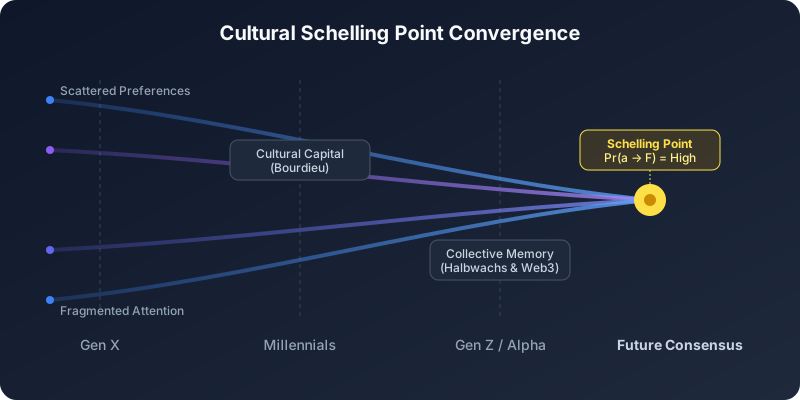
- : Cultural focal point or “Schelling point”
- : The probability that artwork evolves into an intergenerational common reference
- : The group coordination utility generated after becoming a cultural focal point
Schelling’s focal point theory posits that in the absence of sufficient communication, individual behaviors spontaneously converge toward prominent, easily orchestratable common references. Hutter & Frey (1997) noted that the evolution of art’s cultural value is fundamentally a collective coordination process. Maintaining and elevating the evolutionary probability is critical for realizing cross-cyclical value transmission.
Blockchain: The Underlying Infrastructure of Civilizational Memory
Blockchain: The Underlying Infrastructure of Civilizational Memory
Examined from the intersection of finance and distributed ledger technology, Web3 technology directly empowers the consensus value and maximally reduces the friction cost .
Verifiable Distributed Consensus Mechanism:
The on-chain asset provenance, immutable transaction records, and DAO governance trails collectively construct the “underlying infrastructure of civilizational memory”. This mechanism transforms the fragile collective memory—traditionally reliant on centralized authority endorsement—into a distributed consensus equipped with absolute verification capability at the mathematical level. This paradigm shift not only eliminates trust friction in intergenerational transmission but also endows artworks with robust cross-group coordination capabilities.
References
- Simon, H. A. (1971). Designing Organizations for an Information-Rich World. Read Document
- Bourdieu, P. The Field of Cultural Production. Read Document
- Hutter, M., & Frey, B. S. (1997). On the Influence of Cultural Value on Economic Value. Read Document
- Consolidating temporal effects on aesthetical practices: Evidence from China. ScienceDirect. Read Document