

The Traditional Dilemma:
Longstaff’s (1995) classic model demonstrates that “non-tradability” causes a significant discount on asset value. This discount is essentially the value of a Lookback Option—when unable to sell, investors are forced to bear the risk of the price falling back from its peak. The longer the lock-up period , the greater the discount.The RWA Advantage:
After tokenization, fragments can be traded on DEXs at any time, compressing from several years to almost zero. Even if the asset’s fundamentals remain unchanged, merely eliminating the non-tradable period can cause the theoretical value to jump significantly.
When , the asset not only eliminates the liquidity discount but also generates a Liquidity Premium. Tokenized art has real-time fair value (Mark-to-Market) and can be integrated into lending protocols like Aave and MakerDAO as collateral. Art transforms from a “static asset” into an “interest-bearing asset” or “credit foundation.”
Fragmentation & Portfolio Optimization: Efficient Frontier Expansion
Fragmentation & Portfolio Optimization: Efficient Frontier Expansion
The Traditional Dilemma:
In the Markowitz (1952) mean-variance framework, a realistic constraint is that a single piece of art starts at a million dollars and is indivisible, constituting an extremely high investment floor . This prevents small investors from allocating to art.The RWA Advantage:
Tokenization reduces the minimum investment unit from to (at the level of a few dollars). The feasible region expands, the efficient frontier shifts significantly up or to the left, and the overall Sharpe ratio improves.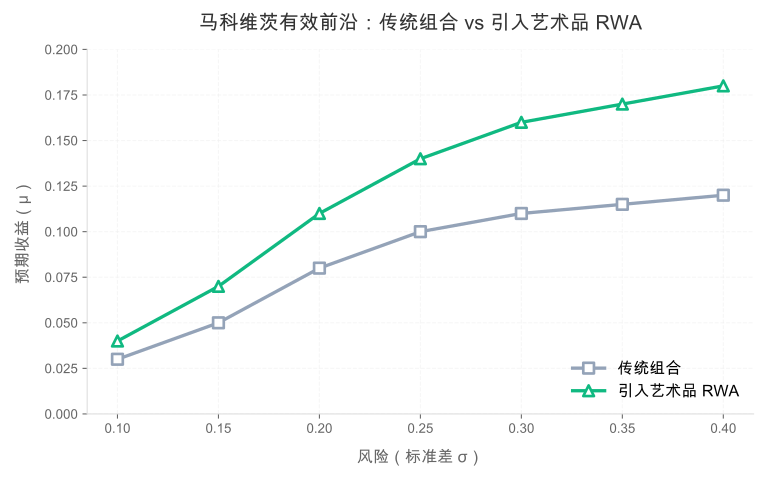
After tokenization, transaction fees are extremely low, allowing the use of automated vaults or grid strategies for high-frequency Dynamic Rebalancing. It even allows small capitals to engage in Dollar Cost Averaging (DCA).
Price Discovery Efficiency: Accurate Convergence
Price Discovery Efficiency: Accurate Convergence
The Traditional Dilemma:
Based on Kyle’s (1985) model, traditional auctions are held a few times a year with participants limited to a small circle, resulting in a huge degree of information asymmetry () and poor market liquidity ().The RWA Advantage:
After tokenization, art enters a globalized on-chain market:
- The base of traders increases dramatically, amplifying the standard deviation of noise trading volume (liquidity improvement).
- Informed traders expand from a few experts to global curators and data scientists, gradually reducing prior uncertainty .
The game between authoritative off-chain valuations (slow variable) and on-chain AMM spot prices (fast variable) constructs a Time-Weighted Average Price (TWAP) through decentralized oracles, allowing prices to converge more accurately to the “hidden truth” of the asset.
Continuous Liquidity: The AMM Curve
Continuous Liquidity: The AMM Curve
The Traditional Dilemma: Market making for traditional art relies on the capital of brokers, resulting in extremely high spreads.The RWA Advantage:
The AMM constant product model () directly provides liquidity without the need for matching buy and sell orders. Fragmentation allows small token holders to provide liquidity, pushing exponentially beyond the capital of traditional market makers. The effective spread of tokenized art is far lower than the traditional auction commission (20%–30%), achieving mathematically decentralized liquidity.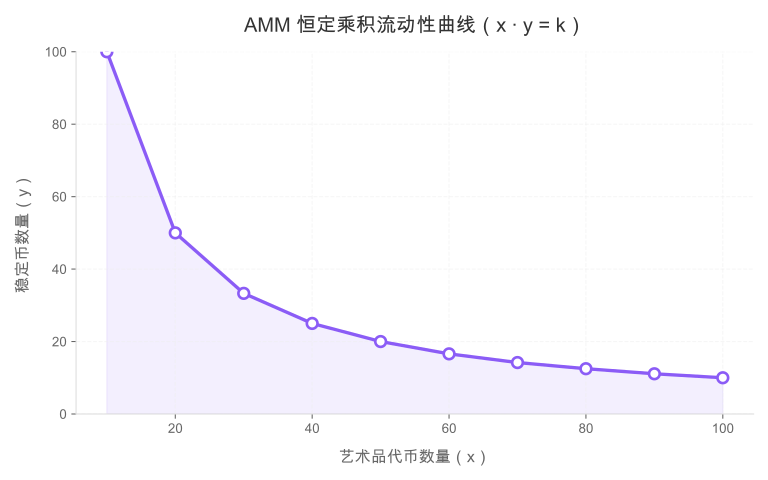
Under concentrated liquidity models like Uniswap V3, for art with stable short-term prices, the local value can be amplified by dozens of times. Even mid-to-small cap art RWAs can offer a low-slippage experience comparable to blue-chip stocks.
Network Value Growth: Super-Linear Feedback
Network Value Growth: Super-Linear Feedback
Theoretical Model:
Metcalfe’s Law states that the value of fungible tokens has a super-linear relationship with the size of the community network: or .The RWA Advantage:
When tokenized art is communally owned, each holder naturally becomes a propagator and curatorial driver. The low barrier to entry allows to grow exponentially, activating super-linear value feedback—a mathematical structure that a single physical collection cannot achieve.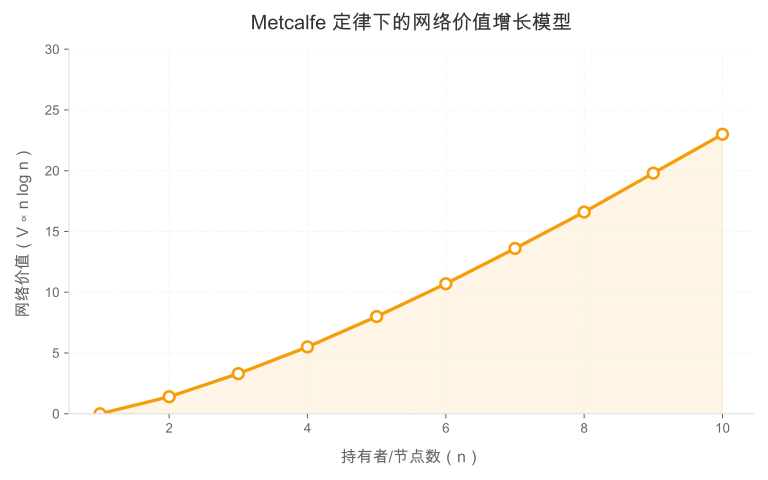
Holders can exercise voting rights through a DAO—deciding on art lending, secondary creation authorization, etc. Governance rights themselves have pricing room. The larger the , the higher the cultural meme and commercial authorization income.
References
- Longstaff, F. A. (1995). How Much Can Marketability Affect Security Values?. The Journal of Finance. Read Document
- Markowitz, H. (1952). Portfolio Selection. The Journal of Finance. Read Document
- Kyle, A. S. (1985). Continuous Auctions and Insider Trading. Econometrica. Read Document
- Adams, H., et al. (2020). Uniswap v3 Core. Read Document
- Metcalfe, B. (2013). Metcalfe’s Law after 40 Years of Ethernet. Computer. Read Document